My wife, Amber, has heard me say some version of this for years: businesses love making money, but they do not always seem interested in making more money.
I know. A little unfair. Some business owners work themselves into the ground trying to keep the lights on. I get that. But every once in a while I come across something so simple, so obvious and so completely avoidable that I have to wonder whether we have all become a little too comfortable with the way things have always been done.
My latest example involved a movie theater, a craving for candy and a question that apparently belonged in the advanced mathematics section of the concession stand.
It started with sugar-free candy. Or rather, the lack of it.
The other day I was at Harkins Lake Pleasant CINÉGRILL in Peoria, Arizona. I wanted some candy, but I was looking for a sugar-free option. Nothing fancy. Just something sweet to eat while watching the movie without buying the regular version.
So I asked. I was told they did not sell any sugar-free candy.
What?
It was not a dramatic scene. I did not clutch my pearls, demand a manager or launch into an interpretive dance about consumer choice. I just thought it was strange. And then the marketing part of my brain took over, which, if you know me, is not always the most relaxing development.
Here is why the answer surprised me. The published CINÉGRILL menu lists classic candy options alongside drinks such as Coke Zero, Diet Coke and Diet Dr Pepper. So reduced-sugar preferences are already part of the beverage assortment. The same publicly available menu did not list sugar-free candy when I reviewed it. Menus and in-store inventory can change, and my experience was at this one location, not every Harkins theater.
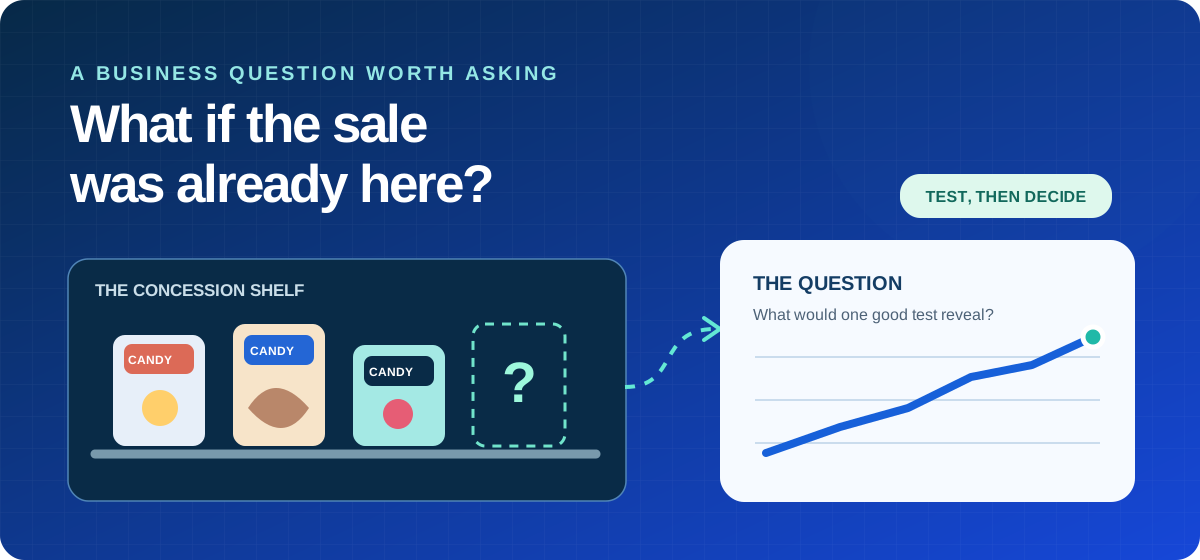
Still, if you will stock a zero-sugar soda, why not test a zero-sugar candy to go with it?
We're not talking about inventing a new product. Hershey sells Zero Sugar versions of familiar candies. Other confectioners have similar options. A theater could evaluate a few shelf-stable products without rebuilding its kitchen or buying an industrial candy-making machine. Which, granted, would be a pretty incredible piece of theater equipment.
“I'd buy sugar-free candy.”
Diet and zero-sugar fountain drinks appear on the menu.
No sugar-free candy appeared on the menu reviewed.
This is not some obscure consumer preference
According to the International Food Information Council's 2025 Food & Health Survey, 75% of Americans said they were trying to limit or avoid sugar. Specifically, 61% said they were limiting it and 14% said they were avoiding it. Those are survey findings about dietary intentions, not measured sales of sugar-free movie candy.
And that distinction is important. I cannot take a national food survey, multiply 75% by the people in a theater and declare that three-quarters of them want sugar-free Reese's. That would make for an exciting spreadsheet and a terrible business plan.
But it does tell us that being mindful of sugar is hardly a fringe behavior.
A survey of U.S. adults, not a projection of movie theater candy sales.
61% Trying to limit sugar
14% Trying to avoid sugar entirely
25% Neither
There is also an important labeling distinction here. Sugar-free and no-added-sugar are not the same thing, and neither necessarily means low-calorie or low-carbohydrate. The point is about offering a choice to customers who want it, not promising that candy has become a health food.
Those last two figures explain why I started looking at the economics. Major exhibitors track concession spending per attendee because small changes in buying behavior add up. In its 2025 annual filing, AMC even points to the percentage of guests making food and beverage transactions as one reason per-patron spending changed.
There is something wonderfully straightforward about that. A theater can increase concession revenue through price, purchase frequency, basket size or some combination. If somebody wants an item the theater does not carry, price optimization is not the problem. Availability is.
The actual problem is unmonetized intent
Marketing people spend an extraordinary amount of time obsessing over acquisition. Traffic. Impressions. Click-through rates. Leads. Conversion rates. Retargeting. Probably a dashboard that has not been opened since March.
And yes, finding new customers matters. It always will.
But what about the customer you already have? The one in your building, on your website or on the phone? The person who already knows your business, trusts it enough to buy and might happily spend another few dollars if you offered the right thing?
There are at least three different ways businesses can miss that opportunity:
A customer wants a relevant product, but you do not carry it.
A complementary product exists, but nobody offers it at the natural moment.
A need repeats, but you make the customer start from zero every time.
My movie theater experience fits the first category. A story from one of my earlier jobs fits the second. We'll get to that in a moment.
This is not just intuition. A 2025 systematic literature review of 147 research papers found an overall positive relationship between cross-selling, upselling and add-on selling and commercial performance. Importantly, the review also found that these techniques work through different mechanisms. Relevance and targeting matter. “Would you also like this completely random thing?” is not a strategy.
What could one missing candy option be worth?
I wanted to put actual numbers behind this thought. Here is the first thing I learned: I could not find reliable public attendance figures or product-level concession sales for Harkins Lake Pleasant CINÉGRILL. So I cannot responsibly tell you what that location loses each year by not stocking sugar-free candy.
What I can do is show how the math works for an illustrative theater. The following model uses 225,000 annual admissions solely as a scenario input, a $5.50 product price based on the previously reviewed CINÉGRILL menu and three hypothetical rates of genuinely additional buyers who would not otherwise have bought a snack.
That last phrase is the entire ballgame. If someone buys sugar-free candy instead of regular candy, the theater has changed its product mix, not necessarily increased its revenue.
Assumes 225,000 admissions, a $5.50 purchase and no substitution from another item. Not a forecast for Harkins.
| New buyers | Candy units | Gross annual sales |
|---|---|---|
| 0.5% | 1,125 | $6,187.50 |
| 1.0% | 2,250 | $12,375.00 |
| 2.0% | 4,500 | $24,750.00 |
So even a one-percent incremental purchase rate in that made-up theater equals $12,375 in annual gross sales. Is that going to transform the movie business? Of course not. But that is one item at one location. Now imagine finding several equally modest opportunities across a product assortment, and then across multiple locations.
The dollars begin to look less adorable.
And no, we should not confuse gross sales with profit. Cinemark reported concession supply expense equal to 18.9% of concession revenue in 2025, but that is a company-wide average, not the wholesale cost of a zero-sugar candy SKU. A serious test needs its own product cost, shrink, shelf-space and handling economics.
Try the revenue math yourself
Change the assumptions to see potential incremental gross sales across your locations. Visits, buyer rate and item price are assumed to be the same at each location. This is a scenario calculator, not a claim about any particular business.
Formula: number of locations × annual visits per location × (genuinely additional buyers ÷ 100) × item price. Excludes product cost, labor, shrink, cannibalization and taxes.
The mattress store that could have sold so much more
Years ago, I worked at a mattress store, and I still remember being surprised by how little effort went into selling anything beyond, well, mattresses.
There were no meaningful add-on products displayed at the front register. No carefully chosen accessories waiting at the exact moment somebody was already purchasing a bed. I suggested it to the owner. He was not interested.
To be fair, I did not have a randomized controlled trial tucked into my pocket at the time. I could not prove exactly how much revenue we would have generated. But the opportunity felt painfully obvious.
What does a person buying a mattress potentially need? New pillows. A mattress protector. Sheets. Pillow protectors. A topper. Maybe a frame or an adjustable base. The big retailers clearly recognize these related categories. Mattress Firm's accessory assortment includes many of them.
This is the rare sales opportunity where you do not need to educate the customer about why the category is relevant. They have just bought a mattress. The connection is practically introducing itself.
A person buying a mattress is one of the most qualified bedding-accessory prospects on the planet. And our register had... a register.
There is experimental research behind the broader point, although we need to be precise about what it proves. One grocery checkout experiment found that sales of a promoted nutritious food rose after the item was placed at checkout with a price promotion. Weekly sales in intervention stores increased from an average of 5.83 to 15.83 units. The study does not isolate placement from the discount, and a grocery store is not a mattress showroom. But it reinforces the idea that point-of-purchase merchandising can change behavior.
At the time, I did not want the store to pressure someone into a collection of overpriced accessories they did not need. I wanted us to make useful products easy to discover and purchase.
There is a difference.
Five other places small businesses quietly leak revenue
Once you start looking for this, it becomes hard to stop. These are practical opportunities to evaluate, not proven missed sales at any specific business.
The salon without take-home products
A stylist uses a product on a client, explains why it works and then sends the client home without an easy way to buy it. A curated retail shelf or post-appointment recommendation can serve existing demand. Square's 2025 beauty report discusses retail and memberships as revenue opportunities.
The menu that never asks the next question
A customer orders a sandwich. They might appreciate a side, a drink or a dessert, but nothing on the menu or ordering screen makes the pairing obvious. Contextual suggestions beat a random blanket upsell.
The service call without a maintenance option
An HVAC company finishes a repair but never explains what an optional preventive maintenance plan includes. Not every household wants one, but service-plan revenue and renewals are established things operators measure.
The shop without gift cards
A loyal customer wants to introduce a friend to a restaurant, salon or boutique. The simplest prepaid purchase is unavailable. A 2026 Square survey found that 26% of respondents said digital gift cards would make them more likely to frequent a local business.
The main product without the obvious companion
A bike store sells a bike but hides the lights and locks. A pet groomer finishes a service but has no appropriate at-home brush to recommend. A relevant accessory can save customers an extra trip and increase basket value.
The customer is already there
These are not elaborate expansion strategies. Each begins by asking what the existing customer might reasonably want next, then whether it pays to offer it.
Not every new product is a good idea
Here is where I am going to argue with my own premise for a moment. Because yes, I can hear the retail operators reading this and shouting, “Do you know what it costs to manage another SKU?”
Fair point.
Inventory costs money. Shelf space is not infinite. Every option adds complexity. Slow movers tie up capital. Promotions can push people into a cheaper option rather than an additional purchase. A badly chosen add-on can annoy customers, damage trust or even reduce average order value.
There is research showing that product assortment decisions can affect purchasing across multiple categories, sometimes in unintuitive ways. “More choice” is not a universally correct answer.
So I am not arguing that Harkins should stock 42 flavors of sugar-free candy. I am not arguing every mattress store should turn its register into a Bed Bath & Beyond tribute museum.
I am arguing that a business should be curious enough to test relevant opportunities when it can do so cheaply.
The question is not simply, “Could we sell this?”
The question is, “Would this create enough incremental contribution after costs and displacement to justify the effort?”
Before you add an upsell, go meet the market
There is a step between “I think we could sell this” and ordering enough inventory to build a small fort in the stockroom: finding out whether the problem exists beyond your own very convincing opinion.
My candy request is a useful starting point. It is still one request. Before adding sugar-free snacks, I'd want to understand who wants them, what those customers buy now and whether the missing option actually changes their spending.
The Small Business Administration's market research guidance recommends examining demand, alternatives and pricing, and identifies surveys and interviews as ways to learn directly from customers. Industry reports provide context. Your own market needs a closer look.
Market visits help you understand what a survey cannot show you
A market visit means spending time where customers make decisions or use what you sell. For a local retailer, that could mean observing the shopping experience and, with permission, talking to customers about a recent purchase. For a business selling to other businesses, it could mean visiting a customer's workplace to see the task your product supports.
The purpose is to learn. Leave the sales pitch out of it. Watch where people hesitate, what they ask staff and what they do when an option is missing. Talk with regular customers, occasional buyers and people who considered your business but went elsewhere. The people who already love everything you do are only part of the picture.
At the mattress store, I'd want to know what happened after the mattress purchase. Did customers already own suitable accessories? Did they buy elsewhere? Was price the issue, or did nobody explain the options? Those answers could lead to very different decisions about what to stock.
Ask about the last purchase, not the imaginary perfect one
I'd start with questions like these:
- “Walk me through the last time you bought this. What else did you need?”
- “What did you do when you couldn't find the option you wanted?”
- “Where did you buy the related item, and what did you pay?”
- “What made you decide against buying anything else?”
Keep notes on what people actually describe, including the answers that challenge your idea. A suggestion for a new product might point to a different problem: unclear information, an inconvenient package size or an option you already sell that nobody can find.
Use surveys to check whether the pattern reaches further
After those conversations, a short survey can explore whether similar needs appear across a broader group of relevant buyers. Pew Research Center's guidance on survey questions explains why wording, answer choices and question order matter, and why questions should be tested before a survey goes out.
For the theater example, ask what snacks people bought on their most recent visit, whether they looked for an unavailable option and what they did instead. Ask about sugar-free candy separately from drinks or other snacks. Include room for “none” and “I don't remember,” where appropriate.
“Would you love more delicious snack choices?” practically brings its own applause sign. It tells you very little about which product deserves shelf space.
Also record who answered and how you reached them. A voluntary poll of your social followers can produce useful leads, but it does not automatically represent everyone who visits your business. Treat stated interest as a clue, not a purchase order.
A market visit helps you find the question. A survey helps you explore the pattern. A real sales test helps you decide whether to keep the offer.
Put the findings together before choosing an upsell or cross-sell. Look for a recurring need, evidence of what customers already do or spend, and a practical way to serve them profitably. Then test a small offer. Research should help you choose the experiment, not become an excuse to avoid making a decision forever.
How I'd test a missed revenue opportunity in 30 days
You do not need a consulting engagement, a giant strategy deck or seventeen people debating a shade of blue. Start with one customer problem and one small experiment.
- Week 1: Visit, observe and ask. Spend time with relevant customers and ask about recent buying experiences. Ask employees what people request but cannot buy. Review search terms, support tickets and checkout questions. Make a shortlist of recurring needs, including evidence that challenges your assumptions.
- Week 2: Check the pattern and pick one test. Where useful, run a short, neutrally worded survey with relevant buyers. Compare the answers with your visits and transaction data. Choose one complementary product, ordering prompt or optional service plan to test. Estimate unit economics and decide in advance what success would look like.
- Week 3: Make the offer visible. Put it where the decision happens, not somewhere customers have to hunt for it. Train staff on a helpful, low-pressure explanation. Track exposure and purchases.
- Week 4: Review the actual economics. Compare attach rate, units, gross profit after direct costs, stockouts, customer feedback and whether existing product sales fell. Keep, change or remove the test based on the evidence.
Thirty days is a starting framework, not a deadline for forcing a conclusion. If reaching the right buyers, gathering useful responses or observing enough purchases takes longer, extend the test.
Measure more than revenue. The handful of numbers I'd want on a simple scorecard are attach rate (purchases of the new item divided by relevant transactions), average order value, incremental contribution margin after direct variable costs, cannibalization of existing products, inventory turns and, where appropriate, repeat purchase.
A test can increase gross sales and still be a bad idea. If half the buyers were going to buy something else, or the new item routinely expires on the shelf, we need to know that. Otherwise the business is not optimizing revenue. It is just giving itself more work.
The opportunity is rarely hidden. Our habits are.
I keep coming back to the same mental image: a customer at a counter, already willing to buy, asking for a product the business does not offer.
Not every request deserves a new SKU. Not every suggestion deserves a yes. But a customer asking to spend money is information. So is an accessory that naturally belongs with the core purchase. So is a service that customers need again and again.
We spend so much time trying to attract the next customer that sometimes we forget to properly serve the person standing in front of us.
And as someone who has spent a lot of his career in marketing operations and SEO, I find that fascinating. Businesses will invest in bringing a visitor to a website, a showroom or a theater. Then they sometimes ignore the easiest ways to make the existing visit a better and more valuable experience.
Would sugar-free candy become a blockbuster concession category? I have no idea. That's exactly why I'd test it.
Because what bugs me is not that a theater lacks a product. It's that an inexpensive question may never have been asked in the first place.
Complacency isn't failing to know the answer. Sometimes it's failing to ask the question when finding the answer would be inexpensive.
Amber will probably tell me I've spent an impressive amount of time thinking about one bag of candy.
She's not wrong. But to me, it was never really about the candy.
Questions business owners might be asking
What is a missed revenue opportunity?
It is potential spending a business could capture from existing demand but does not, because the right product, offer, channel or repeat-purchase process is missing. It becomes a verified missed opportunity only after testing or reliable transaction data shows that the spending would have been incremental.
What is the difference between upselling and cross-selling?
Upselling encourages a customer to choose a higher-value version of the original purchase. Cross-selling offers a complementary product or service. Both should improve customer fit, not just the receipt total.
How do you calculate potential revenue from a new add-on?
For a first-pass scenario, multiply annual relevant customer visits by the share who would make a genuinely additional purchase, then multiply by the item's selling price. Subtract product cost, incremental labor, inventory losses and any displaced contribution from existing purchases before treating the result as a profit opportunity.
Should every business add more products?
No. A new offering needs enough demand and contribution to justify inventory, shelf space, staff time, customer complexity and the risk of substituting existing purchases. A small pilot is usually more useful than guessing.
Sources and methodology
This article combines two firsthand experiences, third-party public research and clearly labeled hypothetical calculations. My experience at Harkins describes one visit. It is not an audit of all locations, and the scenario chart is not a statement of Harkins' actual financial performance. Vendor surveys are identified as such and should not be treated as independent experiments.
- Harkins CINÉGRILL food and drink menu.
- Harkins CINÉGRILL concept.
- 2025 IFIC Food & Health Survey, sugars and sweeteners.
- Hershey Zero Sugar product range.
- Cinemark, 2025 Form 10-K.
- AMC, 2025 Form 10-K.
- Do Sales Mechanisms Pay Off? Systematic Literature Review (2025).
- Checkout-lane sales experiment, PubMed.
- Mattress Firm bedding and sleep accessories.
- Square beauty industry trends, 2025.
- Housecall Pro service plan reporting.
- Square Local Economy Report, 2026.
- FDA: Added Sugars on the Nutrition Facts Label.
- American Heart Association: Sugar free versus no added sugar.
- Assortment and multi-category purchasing, Journal of Marketing.
- U.S. Small Business Administration: Market research and competitive analysis.
- Pew Research Center: Writing Survey Questions.
Think your business might have a few of these gaps?
I'd be happy to take a look with you. My free 30-minute Marketing Checkup is a conversation about where customers find you, where they fall through the cracks and where a simple change could help.
Book a Free Marketing Checkup