You've probably seen it a thousand times. You're looking for someone to replace your roof, remodel the kitchen, repair your air conditioner, or install a pool. You start browsing websites, and nearly every contractor proudly advertises the same three words: licensed, bonded, and insured.
Sounds reassuring, doesn't it? It makes a business look legitimate. And to be fair, these credentials can tell you something important.
But here's what I wanted to understand: if the contractor damages your home, walks away halfway through the job, or installs something that needs to be torn out and rebuilt, which of those three words actually helps you?
I started digging into this because it's easy to see those words and assume you're completely protected. Turns out, that's not necessarily the case. So let's unpack them in plain English, with Arizona-specific examples and actual places to verify the claims.
First, three different kinds of protection
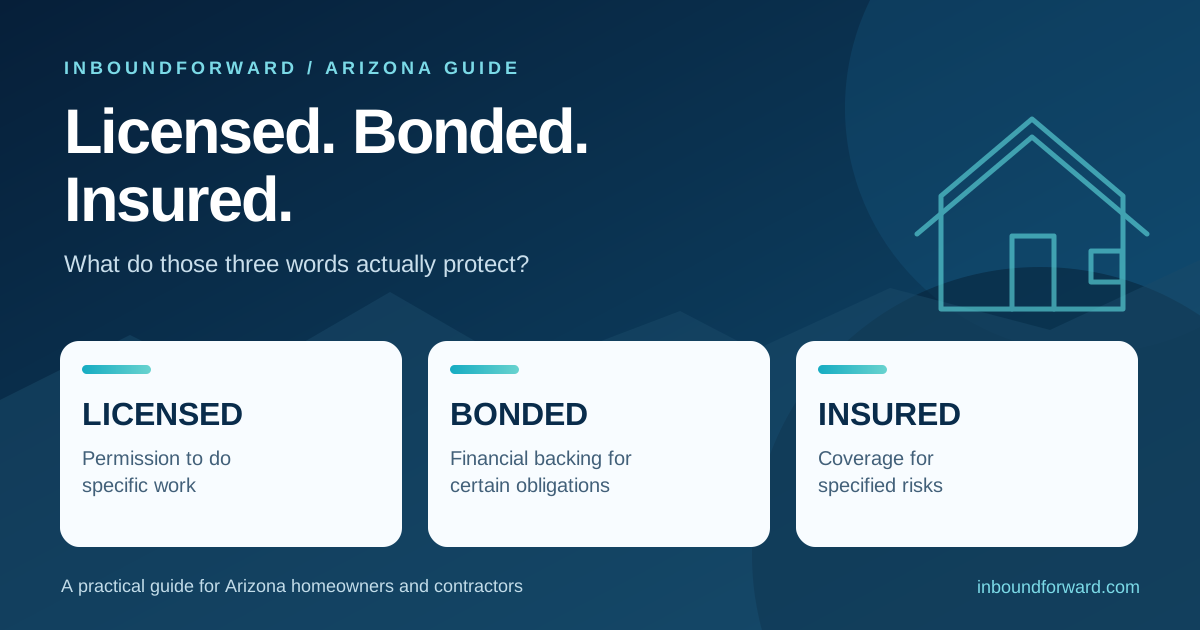
They sound like a package deal. They aren't.
Licensed
PermissionAuthorized to do work within a defined license classification.
Not a guarantee of quality.Bonded
Financial guaranteeCertain legal or contractual obligations have financial backing.
Not an unlimited refund.Insured
Risk coverageInsurance responds to specified accidents and claims, subject to policy terms.
Not a workmanship warranty.1. Licensed: Is the contractor legally allowed to do this work?
In Arizona, the Registrar of Contractors (ROC) licenses businesses to perform particular kinds of construction work. Applicants must satisfy licensing requirements, which can include experience, examinations, and financial obligations.
That's useful accountability. But here's where people get tripped up: not all licenses cover the same work.
Imagine a backyard renovation in Peoria. You want a swimming pool, new electrical lighting, a covered patio, and updated landscaping. Someone shows you an active license. Great! But a painting license doesn't automatically authorize a major electrical installation. You need to verify the classification and scope of work, not just the existence of a license.
The ROC publishes its license classifications, and its contractor search lets you review the record associated with the business.
The company name matters, too
Arizona contractor licenses generally belong to business entities, not to anyone who happens to hold a business card. If your estimate says one company, the license belongs to another, and you're being asked to pay a third, I'd be asking questions.
The ROC recommends contacting the company at the phone number listed in its official license record to confirm that the person negotiating the job is actually associated with the licensed business. That's a smart step, particularly if you found the company through an ad or a social media post.
Does licensed mean good?
No. And I wish it did, because hiring someone would be considerably easier.
A contractor can meet the state's requirements and still be difficult to reach, miss deadlines, or produce disappointing work. Treat a license as an essential starting point for work that requires one. Then check references, completed projects, and available complaint history.
2. Bonded: What happens if the contractor doesn't follow through?
Of the three words, bonded might be the most misunderstood. It sounds like there's a pile of money waiting somewhere to pay you back if the project goes sideways. Not quite.
A surety bond is a financial guarantee that involves the contractor, a surety company, and the party requiring the bond. Eligible claimants may have rights when covered obligations are violated, but those rights come with rules and limits. And unlike ordinary insurance, a surety that pays a valid claim can generally seek reimbursement from the contractor.
Arizona licensed contractors must maintain an appropriate contractor license bond or qualifying financial security. The required amount varies by classification and anticipated work volume.
A license bond is not a project-completion guarantee
Let's say your kitchen remodel costs $50,000. You've paid $25,000 when the contractor stops showing up. The contractor has a valid license and a license bond.
Can you recover your money through the bond? Possibly, if you're eligible and can establish a valid claim. But the bond amount may be much smaller than the loss, multiple claims may share its limit, and the claim process isn't as simple as requesting a refund.
A contractor's license bond and a performance bond are different products. A performance bond is generally tied to a specific project and its contractual performance requirements. A separate payment bond may protect certain subcontractors or suppliers.
When someone says “We're bonded,” I'd ask: “Do you mean your Arizona license bond, or is there a separate performance bond for my project?”
That's not an accusation. It's a reasonable question about what you're actually buying.
3. Insured: What if someone gets hurt or something gets damaged?
“We're insured” sounds comforting. But it doesn't tell you which policies the business has, how much coverage is available, or whether your particular problem would be covered.
Commercial general liability insurance
General liability insurance may cover certain claims involving accidental bodily injury or property damage arising from the contractor's operations, subject to the actual policy.
Imagine a plumber accidentally damages a water line during your kitchen remodel. Water spreads into the living room, damaging the flooring and furniture. An applicable liability policy may respond to that resulting damage.
Now imagine the installer simply puts the cabinets in crooked, and they have to come back and reinstall them. Is the correction covered by liability insurance? Not necessarily.
Insurance policies often distinguish between damage to other property and the expense of repairing defective workmanship itself. A general liability policy is not a blanket promise that every mistake will be fixed at the insurer's expense.
Workers' compensation insurance
Workers' compensation generally provides benefits for qualifying work-related injuries and illnesses suffered by employees. If a roofer falls from a ladder, workers' compensation may help pay for eligible treatment and lost wages.
Arizona employers generally must carry workers' compensation when they have employees, subject to exceptions. The Industrial Commission of Arizona oversees the system. This coverage helps address the employer's obligations to its workers, but it doesn't automatically erase every other possible liability involved in an accident.
What about commercial auto, umbrella, and builders risk?
Those may matter for larger or specialized projects. A company doing a major renovation with heavy equipment has a different risk profile from someone handling a small repair. Ask what coverage applies to the job, rather than accepting “insured” as the end of the conversation.
The Arizona detail that surprised me
Here's something many homeowners would never think to ask. Arizona generally doesn't require a contractor to carry commercial general liability insurance simply to obtain an ROC license. Workers' compensation requirements are separate.
That means a contractor can have a legitimate, active license and the required license bond without carrying general liability insurance.
So when you see “licensed, bonded, and insured,” don't treat it as one credential that Arizona has verified as a package. Check licensing, bond protection, and insurance separately. The ROC explains this in its Before You Hire a Contractor guidance.
Arizona homeowners have another possible safety net
Arizona operates a Residential Contractors' Recovery Fund, which provides potential financial protection to eligible residential owners and occupants for certain losses involving licensed residential contractors.
The details matter. Not everyone qualifies, payments aren't automatic, and the fund isn't intended to reimburse commercial-property losses.
Know the limits before you count on them.
These are statutory maximums, not guaranteed payments. Claims are subject to eligibility, actual damage calculations, available funds, procedures, and applicable deadlines.
Suppose a licensed contractor abandons a bathroom remodel, and you have to hire someone else to finish the work. You may be able to use the ROC complaint process and, if eligible, seek recovery through the fund. But you'll still need supporting documents and a qualifying claim.
The ROC explains that a residential contractor either participates in the Recovery Fund or posts an additional $200,000 bond. Its Recovery Fund guide lays out administrative and civil claim routes, eligibility and timing requirements. This isn't something I'd assume will cover a bad project automatically.
How I'd verify a contractor before signing anything
Let's say you're getting three quotes for a roof replacement in Vistancia. All three contractors say they're licensed, bonded, and insured. Rather than take the words at face value, here's the practical checklist I'd use.
The six-check contractor hiring checklist
- 1Look up the ROC license.Active status, correct business name, proper classification.
- 2Understand the bond.License bond or separate project-specific performance bond?
- 3Request proof of insurance.Review the certificate and verify coverage independently.
- 4Read the written contract.Scope, price, schedule, permits, changes, and payment milestones.
- 5Keep payments aligned with progress.Understand deposits and never let payments race ahead of the work.
- 6Speak with past customers.Ask about communication, surprises, and how issues were resolved.
Start with the ROC's contractor search
Visit roc.az.gov and look up the business. Confirm the active license, classification, business identity, and available complaint or discipline information. The official record is more useful than a license number printed on somebody's website.
Ask for a certificate of insurance
A certificate of insurance, usually called a COI, summarizes policy information. Check the named insured, coverage types, policy dates, insurer, and liability limits. Then verify current coverage with the broker or insurer using independently confirmed contact information.
Remember that the certificate itself isn't the insurance contract. It doesn't prove that every possible claim is covered, or that a policy can't be canceled after the certificate is issued.
Get the actual agreement in writing
For covered Arizona construction contracts exceeding $1,000, A.R.S. § 32-1158 specifies written information including the contractor's identity, license number, job details, total price, estimated completion date, deposit, and progress-payment schedule. Certain specialized contracts have additional requirements.
Even for smaller projects, I would want the scope and price written down. Specify materials, permits, cleanup, change orders, and the steps for handling disputes. Friendly conversations are great, but they're not much fun to reconstruct six months later.
Keep payments connected to real progress
If a contractor wants $25,000 upfront on a $30,000 project before much work begins, I'd want a very good explanation. Some deposits are justified, especially when materials must be ordered. But a legitimate contractor should explain the payment schedule clearly.
The ROC advises homeowners to keep payments from getting ahead of completed work, avoid cash payments, and make checks payable to the contracting business. Good records help everyone.
Ask about comparable projects
Ask past customers whether the contractor communicated, stayed reasonably close to schedule, and handled problems professionally. Every project can have surprises. How a business handles those surprises says a lot.
Seven red flags I'd pay attention to
- No verifiable license number. If the work requires licensing, don't accept “Oh, we're covered under somebody else's license.”
- Pressure to sign immediately. A discount that disappears if you take 24 hours to check credentials isn't much of a favor.
- Names that don't match. Estimate, license, certificate, and payment instructions should identify the real contracting business consistently.
- No evidence of insurance. A verbal assurance isn't a substitute for checking coverage.
- A huge unexplained deposit. Know what the money is for and when work will actually happen.
- Refusal to put promises in writing. If the detail matters, document it.
- Hostility toward reasonable questions. You're trusting this company with your property and money. Questions are allowed.
One odd detail doesn't prove fraud. Several together are a reason to slow down.
Does every handyman need an Arizona contractor's license?
Not every minor repair requires a contractor license. Arizona has an exemption for certain casual or minor work generally totaling under $1,000 in labor and materials when no local building permit is required and other conditions are met. Read the actual rules in A.R.S. § 32-1121.
The distinction matters. A simple small repair might qualify. A substantial kitchen renovation is another story. You also can't assume that breaking one big project into a stack of smaller invoices makes the licensing requirement disappear.
When in doubt, ask the ROC about the particular job before hiring someone.
What if the project goes badly anyway?
Even when you've checked everything, things can go wrong. The best first step is to document the problem clearly: contracts, estimates, photographs, payment records, change orders, emails, and text messages.
Describe the issue to the contractor in writing and request a response. If it can't be resolved, review the ROC complaint process.
For complaints within its jurisdiction against licensed contractors, Arizona generally applies a two-year period, with starting points that depend on the nature of the project. Other claims and deadlines may differ, so don't assume that every possible remedy has the same clock.
A complaint is not an automatic award of damages. Complex disputes deserve advice from a qualified Arizona construction attorney.
If you're a contractor, there's a business lesson here, too
Now I want to look at this from the other side. If you own a roofing company, remodeling business, HVAC company, or pool contractor, think about what you're asking a potential customer to do.
You're asking them to invite you onto their property, trust your team, and hand over a serious amount of money. You know whether your company is legitimate and experienced. The visitor on your website doesn't know that yet.
Putting “Licensed, Bonded, Insured” in tiny type in your footer isn't much of a trust strategy.
Instead, make your license number easy to find. Explain your actual services and project process. Show real completed work, provide credible reviews, and tell people what happens if there's a problem.
Arizona has specific rules about displaying contractor license numbers in advertising. The ROC's advertising guidance describes when an online advertisement can use a website address in place of the number, provided the business name and ROC number are prominently displayed on the home page, not hidden in the footer.
And from a marketing perspective, this matters. You can spend a fortune driving people to your website through search and paid ads. But if they don't feel confident enough to call you, all that traffic isn't doing much good.
That's the same problem I explored in Your Website Gets Traffic. So Why Isn't Anyone Calling? Trust is part of conversion. Clear, verifiable information gives customers a reason to choose you without resorting to louder claims.
Three words on a website are nice. Being able to back them up is a whole lot better.
Frequently asked questions
Is bonded the same as insured?
No. Bonding is a financial guarantee covering particular obligations. Insurance addresses specified risks under its policies. One doesn't replace the other.
Can an Arizona contractor be licensed without general liability insurance?
Yes. The ROC doesn't generally require commercial general liability insurance simply to obtain a license. Separate workers' compensation rules may apply.
Does contractor insurance pay to fix defective work?
Not automatically. Coverage often depends on whether there is covered resulting property damage or bodily injury, rather than only the expense of correcting deficient workmanship.
If a contractor disappears, does the bond refund my deposit?
Possibly, but only if you have a valid, eligible claim under applicable rules. Limits, deadlines, and other claims may affect recovery.
Where do I check an Arizona contractor's license?
Start with the Arizona Registrar of Contractors and review the official license record, including its business name, classification and current status.
Does the cheapest bid offer the best value?
Not necessarily. Compare the materials, scope, timing, references, insurance, and contract terms along with the price. A cheap estimate can get expensive quickly when critical details aren't included.
Final thoughts: trust, but verify
I don't think most people realize how much responsibility falls on them when hiring a contractor. It's easy to assume the state has verified everything, that insurance covers anything that goes wrong, or that a bond guarantees you'll get all your money back.
That's not how it works. Licensing, bonding, and insurance are valuable protections, but they don't replace a little homework.
Before someone starts working on your house or business, check the credentials, understand what they cover, get the agreement in writing, and keep good records. A few minutes now could save you a lot of frustration later.
And if you're the contractor, make the answers easy to find. Trust shouldn't require a scavenger hunt through your website.
Sources and further reading
Arizona agency guidance and statutes reviewed October 30, 2026. This guide is educational, not legal or insurance advice. Requirements and policy terms can change, and specific disputes deserve qualified professional guidance.
- Arizona ROC: Before You Hire a Contractor. Credential checks, consumer protections, payments, and insurance distinctions.
- Arizona ROC: Bond Information. License bonds and additional residential financial protections.
- Arizona ROC: Residential Contractors' Recovery Fund. Eligibility, maximum awards, and claims routes.
- Arizona ROC: File a Complaint. Complaint procedures and deadlines.
- Arizona ROC: License Classifications. Work permitted under different classifications.
- A.R.S. § 32-1158. Required written contract elements for covered projects.
- A.R.S. § 32-1121. License exemptions, including certain minor work.
- Arizona ROC: Contractor Advertising Requirements. Prominent online license-number display.
- Industrial Commission of Arizona. Workers' compensation information.
Own a contracting business in the West Valley?
I'll help you look at your website through the eyes of someone who's deciding whether to trust you with a big project. We can review your trust signals, contact paths, and how clearly you explain your services.
Book a free Marketing CheckupTalk directly with Brian. No obligation to hire me.