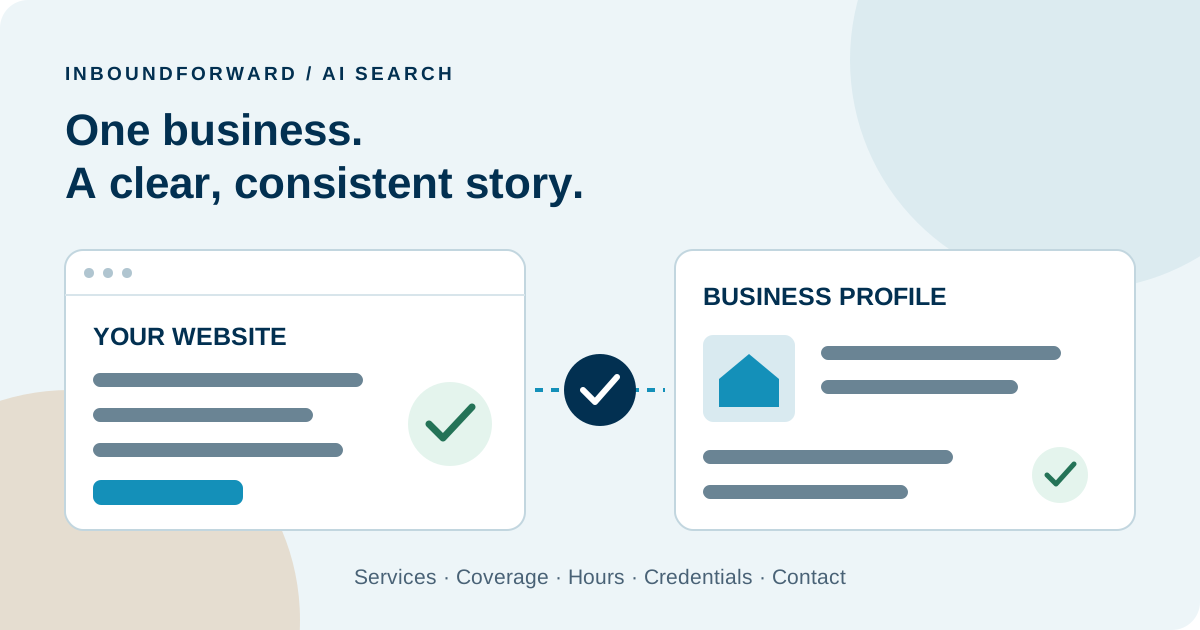
Imagine a homeowner in Vistancia asking an AI search tool whether a roofing company serves the neighborhood. The answer says yes. The company's website says it covers the entire Valley. Then the homeowner opens the booking form and finds out the address is outside the service area.
Everyone sounded confident right up until the part where someone needed a roof.
That's a made-up example, but it raises a useful question for any local business: if your website, your Google Business Profile, an old directory listing, and your scheduling team tell different stories, which one is the customer supposed to believe?
For years, getting found online mostly meant thinking about the search result that brought someone to your website. Now people can also ask a detailed question and receive an answer assembled from several sources. Sometimes they follow the links. Sometimes that answer is enough to decide whether to call, keep looking, or rule you out.
Before spending money on another service promising to make your business “AI ready,” I'd check something more basic. Can someone verify what you do, where you work, when you're available, and how to contact you?
Here's how I'd work through it. The examples below are hypothetical teaching examples, not findings from an audit of Peoria businesses. The platform guidance comes from the official sources linked throughout and listed at the end.
Your homepage is one source, not the whole conversation
Google explains that Business Profile information comes from several sources, including business owners, public websites, licensed data, user contributions, and Google's interactions with a place. Claiming your profile gives you useful controls, but it doesn't make every other source disappear.
AI search introduces another layer. A system may retrieve web information and use it to support an answer. Google describes this in its guidance for generative search. OpenAI also explains that ChatGPT search uses web sources and that results and citations can be incomplete, outdated, or incorrect. A link underneath an answer is a starting point for verification, not a certificate of accuracy.
That doesn't mean a wrong answer proves your website caused it. The system might have used an old source, misunderstood a clear page, or failed to find the information. The useful first move is to inspect the source behind the statement.
One business. Several places to check.
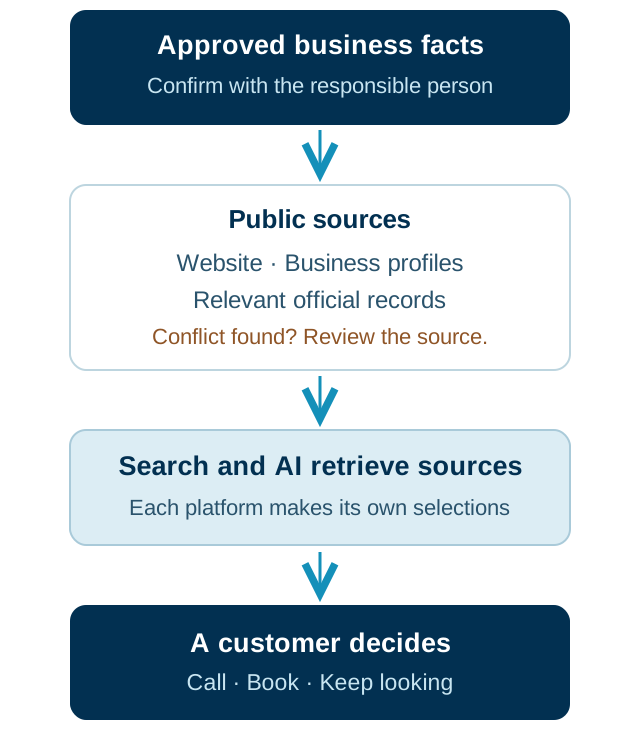
I separate the work into four questions. Can the platform reach the page? Is the fact stated clearly? Do relevant sources agree? Does the platform choose to use the information? We can work on access, clarity, and consistency. Selection remains the platform's decision.
Check the six facts customers need before they call
You don't need to inventory the entire internet to begin. Start with the facts that determine whether a person is in the right place.
1. Who operates the business?
Use your real public business name consistently. If the brand differs from the legal company or professional name on an official record, explain the relationship where a customer can find it. A hypothetical remodeling company might say, “Desert Example Remodeling is operated by Example Construction LLC,” if that is accurate. The answer should come from the actual business records, not whoever is writing the homepage.
2. What work do you actually accept?
“Complete home comfort solutions” doesn't tell me whether you repair air conditioners, replace ductwork, or offer maintenance. State the services plainly and explain meaningful exclusions. A dental practice should confirm which treatments its current team offers. A remodeler that accepts full renovations but not small repairs can save everyone a phone call by saying so.
3. Where do you work?
A physical office, a service area, and a list of places you would like to attract customers are different things. Check coverage with the person who schedules the jobs. If an address near your boundary requires confirmation, explain how to ask. For the page-planning side, I've already covered when separate service-area pages make sense.
4. What does “available” mean?
Office hours, appointment windows, emergency availability, and response times answer different questions. A company can close its office at five while taking emergency calls later. That doesn't automatically make either published schedule wrong. The problem is leaving the customer to figure out what the schedules mean.
“Open” needs a little explanation.
Who answers routine scheduling questions?
Does an appointment need confirmation?
Is someone dispatched, or is a message taken?
What can your team consistently deliver?
5. Can someone verify your credentials?
For Arizona contractors, the Registrar of Contractors recommends checking the license record and the classification covering the work. Dental practices can use the Arizona State Board of Dental Examiners' professional search. Review the actual record before describing a credential. An active credential is not permission to claim every specialty or guarantee every outcome. The longer explanation for contractors is in the licensed, bonded, and insured guide.
6. How does someone take the next step?
Check the phone number, form, and booking link. Then check what happens after someone uses them. A correct phone number that goes unanswered and a successful form that lands in an abandoned inbox create their own problems. Give the customer a realistic expectation about who responds and when.
A one-hour audit you can actually finish
Set aside an hour for a first pass. That's my suggested planning window, not a claim that every business can resolve every issue in sixty minutes. The goal is to identify important contradictions and choose the next fixes.
Spend the hour finding the facts.
- 10 minWrite the approved facts
- 20 minCheck pages and profiles
- 20 minTest questions and sources
- 10 minChoose fixes and owners
First, agree on the correct version
Open a document and write down the six facts above. Include the source supporting each fact, the person responsible for it, and the date checked. For service coverage, the scheduling team may be the right internal authority. For a license, use the issuing agency's record. For office hours, ask whoever runs the office.
This matters because consistency alone isn't enough. Copying an outdated fact into five places gives you five matching mistakes. Establish what is true before making everything match.
Compare your own pages
Check the homepage, service pages, contact page, coverage information, footer, and booking form. Look at the mobile version too. Watch for old phone numbers, unsupported availability promises, services mentioned only in an image, or a form that accepts different locations from the ones the website advertises.
If your site uses structured data, ask your developer to compare it with the visible page. Structured data is code describing page information for machines. A customer might see current hours while the code still contains the old schedule. Both deserve attention.
Check the sources customers encounter
Search your business name and inspect the results. Review your Google Business Profile, Bing listing if you use one, relevant official records, and the directories that actually appear. Start with a few important sources. A spreadsheet containing hundreds of obscure listings can become a very efficient way to avoid fixing your contact page.
Different formatting isn't necessarily a conflict. An abbreviated street name may mean the same address. A tracking number may be intentional. Verify the setup before replacing something that works.
Ask factual questions in search and AI tools
Use the platform's web search feature where available. Include your exact business name and location so you don't accidentally test another company. Try these questions:
Copy, replace the brackets, and test
- Does [business name] serve [city, neighborhood, or ZIP code]?
- What services does [business name] offer?
- What are [business name]'s hours on [specific date]?
- How can I contact or book with [business name]?
- What official source verifies [business or professional name]'s Arizona license?
- Which sources support those answers?
Save the exact question, date, platform, answer, and source links. Note whether you were signed in and what location you supplied. Open the citations and check whether the cited page actually supports the claim. If a tool can't find a license, go directly to the official agency. An AI answer cannot establish that someone is licensed or unlicensed.
Repeat a few questions in a fresh conversation. Answers can vary, and location or account context may affect results. You're collecting examples of what appeared during your tests, not establishing one permanent answer everyone sees.
Mark the problem before choosing the fix
| Label | What it means | First move |
|---|---|---|
| Wrong | The fact doesn't describe the business. | Confirm the correct fact and locate its source. |
| Outdated | It used to be true. | Find the old page or listing still carrying it. |
| Unclear | Two statements need context. | Explain the distinction, such as office hours versus emergency service. |
| Unsupported | The answer gives no source that establishes the claim. | Verify it independently before treating it as true. |
Correct the source, then check the answer again
Start with errors that could stop or misdirect a customer: the wrong phone number, a broken booking link, inaccurate location information, or a service promise the team can't fulfill. Fixing those comes before polishing a paragraph about the company's commitment to excellence.
On your website, put important facts in readable text near the decision they support. Explain coverage on the service or coverage page. Explain emergency availability where someone seeks emergency help. Connect those pages with clear internal links so visitors can find the answer.
For business profiles, use the platform's normal editing process. Google explains that it may update profile details using information from other sources, so review updates as well as submitting your own changes. Keep a note of what you submitted and when.
If an official record is incorrect, follow the agency's correction process. If the record is accurate but uses a legal name customers don't recognize, explain the relationship on your site. Don't treat a public licensing database as another marketing profile.
For an old directory, use its correction or ownership process. Prioritize listings that customers can actually find. If an AI answer cites an outdated page, correcting that page or asking its publisher to update it gives you a concrete place to work. You can also use the AI platform's feedback option, but feedback isn't a promise of a correction or a deadline.
Sometimes every cited source is accurate and the answer is still wrong. Save the example, submit feedback if available, and keep monitoring. Rewriting a correct page repeatedly just to satisfy one changing answer can create more confusion than it resolves.
The technical checks worth asking your developer about
Search tools need access to useful pages. A crawler is software that visits pages automatically. Indexing means a search system has processed a page for possible use in results. Neither means the page will be selected for a particular answer.
For Google, have your developer check that key pages can be crawled, are indexed, and are eligible for search snippets. Review any applicable Search Console controls for generative AI inclusion against Google's current guidance. Check that security rules and page instructions aren't unintentionally preventing the access you want.
For ChatGPT search, OpenAI distinguishes OAI-SearchBot from GPTBot. The former serves search; the latter concerns content that may be used for model training. Those settings are independent. A developer can check whether your robots.txt instructions and hosting security allow OAI-SearchBot access. Allowing access makes consideration possible; it doesn't guarantee placement.
Bing's Webmaster Guidelines likewise connect search and AI experiences to core crawling, indexing, and content clarity. Keep each platform's requirements separate when someone proposes a technical change.
Google also says you don't need special AI markup or an llms.txt file for its search features. If someone recommends either, ask which platform uses it and what evidence supports the expected benefit. A tidy file isn't a substitute for an accurate service page.
And please don't build fifty nearly identical pages hoping an AI tool will eventually trip over one. Publish useful service explanations, real project details you have permission to share, and answers your team can stand behind.
How to tell whether the work helped
Keep three separate records: factual accuracy, visibility, and customer outcomes. They answer different questions.
Being cited and getting a useful inquiry are different outcomes.
Compare answers with current sources.
Review impressions and citations.
Record services, locations, and appointments.
Recheck the same facts
Use the original question set after making corrections, then repeat at a planned checkpoint. My suggestion is an initial review after about a month, with more time when sources update slowly. Record what changed. A corrected answer after an edit is encouraging, but timing alone doesn't prove your edit caused it.
Use the platforms' reports
Google's Generative AI performance reporting announcement says the insights rolled out worldwide by August 31, 2026. The reports show visibility information such as impressions and appearing pages. Review the report available for your verified property and compare consistent periods.
Bing Webmaster Tools' AI Performance report shows citation activity across supported AI experiences. Microsoft cautions that these counts aren't rankings or measures of authority and don't establish why a trend changed. A citation is useful information, but it doesn't tell you whether a homeowner booked an estimate.
Ask the office what changed
For a week before and after the cleanup, record inquiries caused by wrong hours, unavailable services, or locations you don't cover. Track completed forms, suitable requests, and booked appointments separately. Ask how people found you, while accepting that customers may not remember the exact path.
Analytics may identify some AI referrals, depending on the platform and your setup. It won't necessarily identify every influence or visit. Check the labels in your actual reports before telling yourself that every new inquiry came from AI.
If the facts agree but relevant visitors still struggle to contact you, work through the website conversion issues next. Accurate information gets someone to the decision. The contact experience still has to work.
Give the facts an owner and a review date
The most useful improvement may be assigning one person to keep this information current. Otherwise, the website belongs to the agency, the profile belongs to whoever knows the password, and nobody owns the part where they agree.
Review the essentials quarterly and whenever you move, rebrand, change phone numbers, add or discontinue a service, adjust hours, change providers, or revise coverage. Make updating public information part of the operational change.
A short list for this week
- Agree on the six essential facts.
- Compare your website, profiles, and relevant official record.
- Test phone, form, and booking paths on mobile.
- Save factual AI questions, answers, and citations.
- Correct the most consequential sources first.
- Assign a person and a date to recheck.
Plain text. No signup required. Copy it into your own document or print it.
You don't have to solve every possible search problem this afternoon. Start with one important fact and follow it through the places a customer would check. Then move to the next one.
A person deciding who to trust with a roof, an air conditioner, or a dental appointment has enough to think about. Figuring out which version of your business is current shouldn't be another job you give them.
A few questions owners ask
Can I make ChatGPT or Google recommend my business?
You can improve accurate content and access to it, but you can't guarantee a recommendation, citation, or ranking. Each platform decides what to retrieve and show for a particular question.
Does every listing need identical wording?
The underlying facts should be accurate and compatible. Different formats or necessary context can be appropriate. Explain distinctions instead of forcing unlike fields to say the same thing.
What if the AI answer has no citation?
Verify the claim using your own records and authoritative public sources. Save the answer as an observation, and don't assume you know where it came from.
Is this a one-time cleanup?
It becomes maintenance whenever the business changes. Keep a fact sheet, a responsible person, and a repeatable review date.
Want help finding the conflicting story?
Bring one confusing page or business detail to a free, 30-minute Marketing Checkup. We'll talk through what a customer needs to know and where a closer review would help.
Book a free Marketing CheckupTalk directly with Brian. Detailed testing and implementation are separately scoped.
For help with the wider picture, see how I approach search visibility for local businesses.
Sources and further reading
Official guidance reviewed November 2, 2026. This article presents an owner checklist and hypothetical examples. It does not report a completed local-business survey, customer results, or a tested ranking formula.
- Google: how Business Profile and local search information is sourced.
- Google: updates to your Business Profile.
- Google Search Central: AI features and your website.
- Google: optimizing for generative AI features.
- Google: Generative AI performance reports, with rollout update dated August 31, 2026.
- OpenAI: crawler types and search access.
- OpenAI: web search, source checking, and location context.
- Microsoft: Bing Webmaster Guidelines.
- Microsoft: AI Performance reporting and its limits.
- Arizona ROC: license and classification checks.
- Arizona State Board of Dental Examiners: professional search.